
WHAT MAKES VERITAS UNIQUE
CLASSICALLY DIFFERENT
The education Veritas offers its students is unique, proven, and effective. Classical education differs from its modern forms by focusing on teaching how to think and learn, rather than just memorizing facts or educating for the sake of test scores or job opportunities.
The Veritas Classroom is an ordered, beautiful, engaging environment, built upon mutual respect between student and teacher. Veritas teachers, from PK through 12th grade, are tasked with the mentorship of their students through the formation of souls and the engagement of minds.
Veritas School utilizes our proprietary liberal arts-based curriculum that emphasizes critical thinking, logic, and communication skills. It is structured around an updated model of the Trivium, the three stages of grammar, logic, and rhetoric, and utilizes classic literature and Harkness teaching methods to cultivate lifelong self-education, Biblical virtue, and civic character.
THE VERITAS CLASSROOM
Experience the Veritas classroom, where students and teachers share a relationship of deep mutual respect. Veritas teachers serve as mentors, dedicated to the holistic development of each student’s character, intellect, and faith.
Across all grades, Veritas fosters an ordered, joyful learning environment. Veritas classrooms are predominantly analog at the Grammar level, with a thoughtful technology policy in place for Secondary learning, research, and lab study. Personal cell phone usage by students on campus is prohibited. By removing distractions and unease through clear routines and well-articulated expectations, Veritas students can focus fully on learning. With the foundation of order and learning in place, the joys of classroom learning are abundant!
A walk through the Veritas campus reveals vibrant learning in action. You may witness:
-
Third Graders enthusiastically chanting and diagraming English grammar
-
Sixth Graders composing "invectives" against literary villains like Prince John or practicing classical progymnasmata writing exercises
-
Tenth Graders debating the assassination of Julius Caesar, delivering prepared declamations with passion
-
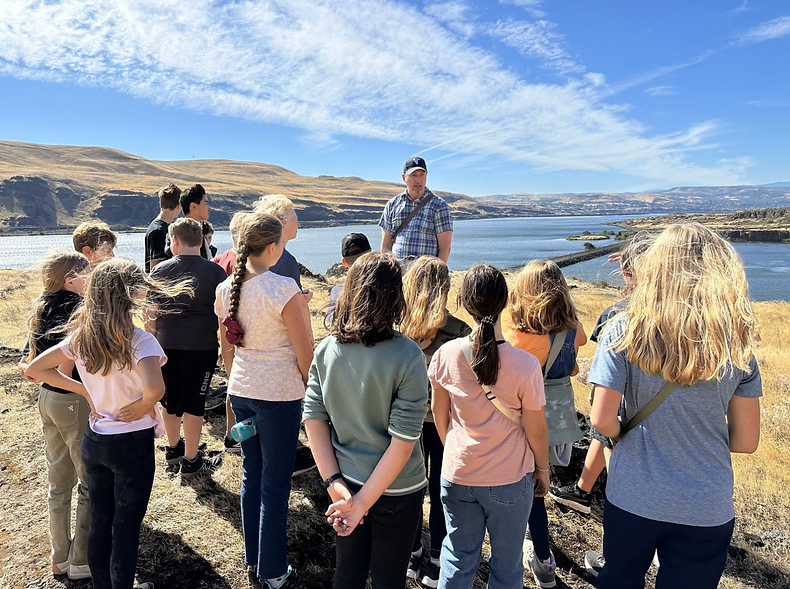
Kindergartners singing joyfully about the solar system, out and about on nature walks, or preparing for their field trips to museums, farms, or libraries.

First Grade
Grammar School

7th Grade
Logic School
While the daily work of school necessarily involves testing and review, each Veritas classroom and each learning activity aims to equip students to thrive while students advance through Veritas' rigorous curriculum. What often surprises students and parents alike is how much joy each member of the Veritas community experiences along the way.
We invite you to visit our classrooms and witness this unique, vibrant learning environment firsthand.
THE TRIVIUM
At Veritas, we seek to challenge children individually at all levels and teach them how to learn by using the centuries-old and well-proven classical method. By adopting an updated version of the Trivium, the name given to the first three of the Seven Liberal Arts, the teachers at Veritas are better able to pass on the invaluable tools of learning that built the foundation of education.
The three parts of the Trivium are:
-
Grammar – memorizing, engaging, and mastering the basic facts of a subject
-
Logic – understanding the relationship of those facts to each other; and
-
Rhetoric – knowing how to effectively communicate this knowledge to others

Grammar School Students
PK - 6th Grade

Logic School Students
7th-8th Grade

Rhetoric Students
9th-12th Grade
Much of Western Civilization – our culture, laws, history, and language – has been built on the heritage of the ancient Hebrews, Greeks, and Romans. For an education to have depth, certain aspects of this heritage need to be studied, understood, and appreciated.
Early Christians developed the classical teaching method, which revolved around what were called the Seven Liberal Arts. This method was utilized through the Middle Ages and into the early 1900s, proving to be remarkably successful.
By adopting an updated version of the Trivium, the teachers at Veritas are better able to pass on the invaluable tools of learning that built the foundation of education throughout this amazing period of history. The Trivium Model is applied to every academic subject through various teaching techniques and activities carefully related to a child’s age and stage of development.
HARKNESS METHOD:
EDUCATION AS SELF-EDUCATION
The Harkness method of teaching is a kind of socratic, discussion-based approach, mainly used in Rhetoric (high school) classes. The method is content-focused and teacher-led, but student-centered; that is, the students carry the load of discussing (and learning how to ask) the questions raised by the content they are studying in class, whether this is Milton’s Paradise Lost, a topic in ancient history, or a problem in mathematics.
Students discuss arranged in an oval and all are expected to be able to articulate their understanding, and to ask questions both of the text and of each other. There is no hiding in a Harkness discussion-careful preparation and a thoughtful search for truth are critical. Ideally, these discussions occur around an oval-shaped table where all students can see and interact with each other.

Since the architecture of a place (and a classroom is no exception) significantly impacts what goes on it in, we have purchased some of these tables for our humanities classrooms, and hope to add more as we’re able. As McLuhan pointed out, the medium is the message. A seminar-style seating arrangement encourages engagement and participation, in contrast to the standardized rows of students focused on the front, which is typical in many classrooms.
Veritas doesn’t approach Harkness discussions as a kind of free-for-all sharing time. Rather, teachers guide students to discuss carefully and thoughtfully, applying both their content knowledge and their biblical worldview to the problems raised. But the bulk of the work in the discussion is placed squarely where it should be: on the students.
An article to learn more:
LEARN MORE
To learn more about what we mean by classical and Christian education at Veritas, browse through the following articles:
3 Habits to Embrace That Teach Your Kids How to Think